Sonia’s forced prostitution
Crime and PunishmentSonia’s forced prostitution is shown not as an isolated choice but as the outcome of mounting pressure inside an impoverished household. In Semyon Zaharovitch Marmeladov’s account, his daughter, Sofya Semyonovna Marmeladova, faces hunger, illness in the family, and the failure of honest work to provide a living. Taking a Yellow ticket brings money home, but it also makes her unable to reside with her family. Her circumstances expose how the household’s survival depends on her sacrifice even as the consequences keep her apart from it.
Family circumstances and the limits of honest work
Sofya Semyonovna Marmeladova is Marmeladov’s daughter by his first wife and the stepdaughter of Katerina Ivanovna. The family has three young children and lives in a crowded, disorderly part of a room at Amalia Fyodorovna Lippevechsel’s lodging house. Marmeladov describes Katerina as generous but quick-tempered, and says that poverty and illness have pushed her to the edge of endurance. She works through the day at household tasks and cares for the children, while her weak chest and tendency to consumption make that labor especially precarious.
The family’s financial distress is worsened by Marmeladov’s drinking. He admits that he sold Sofya’s stockings and a shawl that had been given to her, using the proceeds for drink. His confession places her hardship within a pattern in which the household’s few possessions can be converted into temporary relief for him, while the costs fall on the family. He says that Katerina’s illness has developed into coughing blood, and that the children have gone without food. The account does not treat the household’s crisis as a single misfortune: drinking, illness, hunger, and the absence of reliable income reinforce one another.
Marmeladov presents respectable work as inadequate to the family’s needs. He estimates that a poor girl without special skills can earn less than fifteen farthings a day, even if she works continuously. Sofya had sewn linen shirts for Ivan Ivanitch Klopstock, but he had not paid her for the work and had dismissed her with complaints about the collars. With the children hungry and Katerina unable to provide for them, the small and uncertain returns from sewing cannot meet the family’s immediate need. The options available to Sofya are therefore narrowed by both low wages and the failure of an employer to pay what she is owed.
The decision and its immediate cost
Marmeladov recalls that Darya Frantsovna had tried more than once to reach Sofya through the landlady. In the crisis that followed, Katerina spoke to Sofya in anger and desperation. Marmeladov stresses that his wife was not herself in that moment, but driven by illness and the crying of hungry children; he does not present her remark as a calm or settled demand. Sofya left the room at about six in the evening and returned around nine. She silently placed thirty roubles on the table, then covered herself with the household’s large green shawl and lay down without speaking.
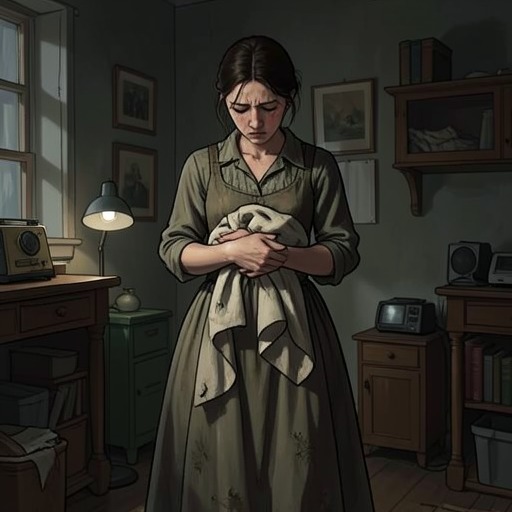
That money marks a change in the family’s immediate circumstances, but Marmeladov’s account makes the cost of obtaining it impossible to separate from the relief it provides. Sofya does not announce what she has done or ask for recognition. Katerina later goes to her and remains with her in an intimate reconciliation; Marmeladov, meanwhile, says he had been lying drunk. The episode places the women’s responses side by side: Sofya brings the money the household needs, while Katerina’s grief and tenderness register the harm behind that support. Marmeladov’s own position as witness is compromised by his inaction and drinking.
The Yellow ticket and separation from home
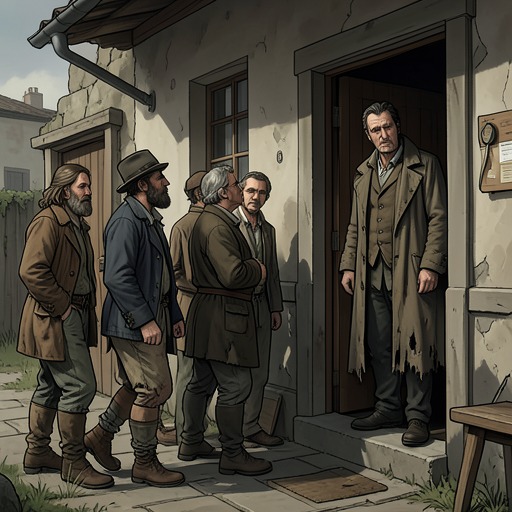
Marmeladov says that, after an incident and information supplied by people he calls ill-intentioned, with Darya Frantsovna playing a leading part, Sofya was forced to take a Yellow ticket. The account gives no detailed description of the procedure; its emphasis falls on the result. Amalia Fyodorovna would not allow Sofya to continue living in the shared rooms, and Mr. Lebeziatnikov also objected. He had first sought to make advances to her, according to Marmeladov, but then invoked his education and standing to reject living in the same rooms with her. Katerina defended Sofya, and the dispute between her and Mr. Lebeziatnikov became connected to Sofya’s exclusion.
Sofya lodges separately in a room partitioned off in the home of the Kapernaumovs, a poor family of tailors. She can no longer simply share the family’s rooms, but the separation is not a break in her relationship with them. Marmeladov says she usually comes to visit after dark, comforts Katerina, and gives the family what she can. The arrangement makes her position contradictory: the status that bars her from the household does not end her responsibility for its members. Her contribution continues, but under conditions that leave her at a distance from the home she helps sustain.
Care, sacrifice, and Raskolnikov’s interpretation
Sofya’s sacrifice becomes a point of comparison when Rodion Romanovitch Raskolnikov considers his sister, Avdotya Romanovna Raskolnikova, and her proposed marriage to Pyotr Petrovitch Luzhin. Raskolnikov interprets the match as a sacrifice made for the benefit of her brother and mother, and thinks of Sofya as an enduring victim. His comparison is not an account of identical circumstances: he distinguishes Sofya’s decision, which he associates with starvation, from Avdotya’s expected marriage, which he fears will bind her to a man she does not respect in return for security and material comfort.
For Raskolnikov, the parallel sharpens the question of whether a loved one’s sacrifice can be treated as an acceptable means of rescuing a family. He objects to the idea that Avdotya should surrender her freedom for his future, and measures that proposed bargain against the hardship Sofya has endured. His reflection does not change the reported facts of Sofya’s situation, but it gives them a wider place in the novel’s moral concerns: deprivation makes private sacrifice appear necessary, while the supposed benefit to others risks obscuring the person who bears its cost. Sofya’s continuing aid to her family, despite her exclusion from their home, makes that cost both material and relational.